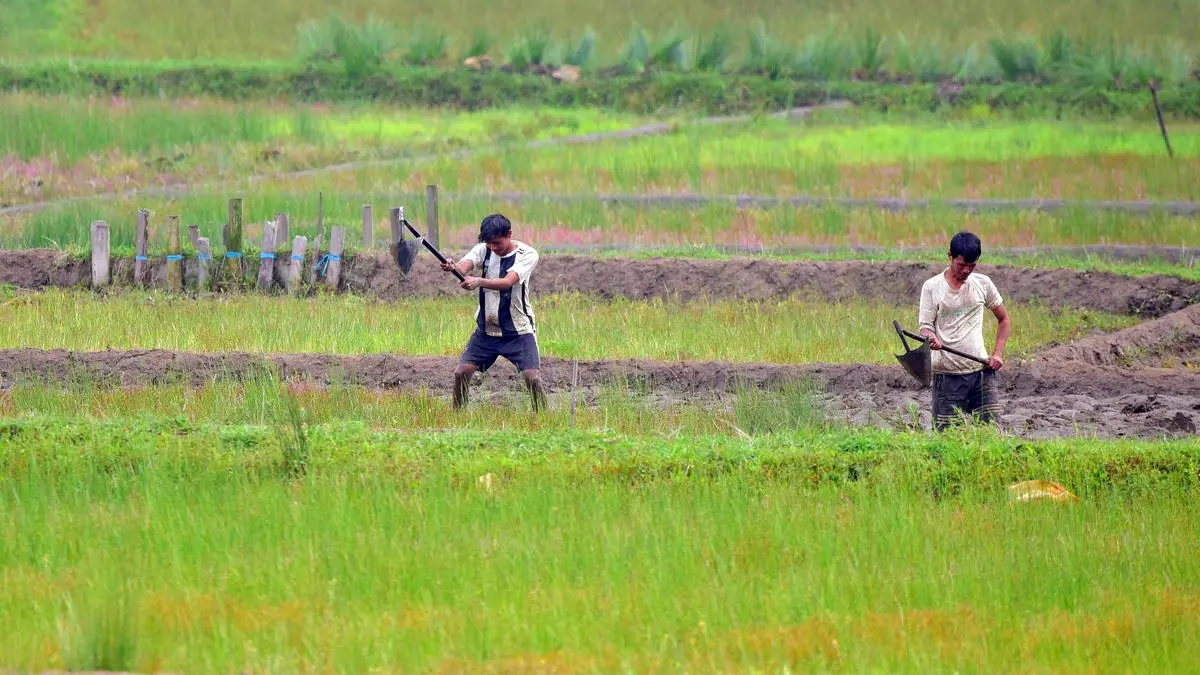
File Photo: Agricultural labourers ploughing a paddy field with traditional farming instruments, in West Khasi Hills, Meghalaya
| Photo Credit:
ANI
Meghalaya state wants to take the total area under organic farming to 1 lakh hectares by 2028 from the existing 27,000 hectares.
A media statement by the Meghalaya Department of Agriculture and Farmers’ Welfare said the area under organic farming increased from 18,000 hectares in 2018 to 27,000 hectares in 2025, and is projected to reach 1 lakh hectares by 2028. Strong certification systems and farmer collectives ensure quality, traceability and consistency.
Mentioning that Meghalaya’s spices are largely organic by default, supported by rich soils and high rainfall, the statement said the state produces over 16,000 tonnes of spices annually, with organic cultivation steadily expanding across districts.
Turmeric
Giving details about Lakadong turmeric grown in the hills of West and East Jaintia, the statement said this GI-tagged turmeric is globally recognised for its rich colour, aroma and exceptionally high curcumin content, ranging between 7 per cent and 12 per cent. Scientific testing by ICAR confirms that Lakadong turmeric ranks among the highest curcumin varieties in the world. The Central government has described it as the ‘Miracle Spice of Meghalaya’.
Under the Lakadong mission, turmeric cultivation expanded to 2,190 hectares, supported by more than 20 processing units that benefited over 13,000 farmers and enabled exports of dried turmeric slices.
Ginger
The Ginger Mission has played a key role in strengthening ginger cultivation and value addition across the State.
It said that more than 19,000 farmers have received free ginger seeds over the last four years, helping expand production at the grassroots level. In 2025 alone, 348 tonnes of ginger were processed, generating ₹1.74 crore through the sale of sliced and dried ginger, with over 1,700 farmers directly benefiting from the initiative.
Highlighting that ginger and black pepper are contributing strongly to rising farm incomes, the statement said ginger production increased from 66,156 tonnes in 2018-19 to 71,413 tonnes in 2024-25, placing Meghalaya among the top ten producers in the country, with clear targets to reach the top five by 2032.
The state has already exported its first ginger consignment of 15 tonnes to Dubai. Black pepper production has grown from 801 tonnes in 2018-19 to 2,267 tonnes in 2024-25, securing a top three national ranking.
In districts such as West and South Garo Hills, integrated village cooperative societies cooperatives have improved price realisation through aggregation, quality grading and direct market access.
Referring to the market access for spices, the statement said over 420 tonnes of ginger, turmeric, black pepper, bay leaf and cinnamon were traded across domestic and export markets between 2022 and 2025. This included value-added forms such as sliced and dried ginger and processed turmeric.
It said that agriculture’s contribution to Meghalaya’s Gross State Domestic Product has more than doubled over the past six years. Under the leadership of the Chief Minister, Conrad K Sangma, it has increased from ₹5,977.91 crore in 2018-19 to ₹12,332.26 crore in 2024-25.
This growth reflects a deliberate shift in approach. Meghalaya have moved beyond subsistence farming to focus on high-value crops, better processing and stronger market access.
Strategy
State’s strategy has focused on crops that reflect Meghalaya’s identity and ecological strengths, including Lakadong turmeric, ginger, black pepper, bay leaf, Kew pineapples and Khasi Mandarin oranges. These products are valued for their quality and are increasingly finding space in premium domestic and international markets. To support this transition, the State government has invested in infrastructure and branding initiatives such as Meghalaya Collectives and Meghalayan Age, while establishing large food processing facilities such as PRIME Hubs under the community public private partnership model.
These interventions enable aggregation, value addition and direct market access for farmers. The objective is to help farmers earn more by selling better, not just by producing more, the statement added.
Published on February 27, 2026