MOVING closer to a bilateral trade pact, India and the US unveiled Saturday a framework for an interim trade agreement to lower tariffs and deepen economic ties after almost a year of negotiations.
Thanking US President Donald Trump for “his personal commitment to robust ties between the two countries”, Prime Minister Narendra Modi said, “This framework reflects the growing depth, trust and dynamism of our partnership… will also strengthen resilient and trusted supply chains and contribute to global growth.”
At a media briefing, Commerce Minister Piyush Goyal underlined that the government has safeguarded sensitive sectors, keeping in mind the interests of domestic farmers and milk producers. “This will open a $30 trillion market for Indian exporters, especially MSMEs, farmers and fishermen. The increase in exports will create lakhs of new job opportunities for our women and youth,” he said.
As the joint statement on the framework reaffirmed the commitment of the two countries to the broader US-India Bilateral Trade Agreement (BTA) negotiations, US President Donald Trump, through a separate executive order, removed the additional 25 per cent tariff imposed on Indian goods over Russian oil purchases saying India was “committed to stop directly or indirectly importing Russian Federation oil”. US officials will monitor and recommend reinstating the tariff if India resumes oil imports from Russia.
Under the decisive leadership of PM @NarendraModi ji, India has reached a framework for an Interim Agreement with the US. This will open a $30 trillion market for Indian exporters, especially MSMEs, farmers and fishermen. The increase in exports will create lakhs of new job… pic.twitter.com/xYSjxML6kt
— Piyush Goyal (@PiyushGoyal) February 7, 2026
On the issue of Russian oil, Commerce Minister Piyush Goyal said questions related to Russian oil should be directed to the Ministry of External Affairs (MEA). The MEA had earlier said that for India, ensuring the energy security of 1.4 billion Indians was the supreme priority of the government. “Diversifying our energy sourcing in keeping with objective market conditions and evolving international dynamics is at the core of our strategy,” the MEA spokesperson had earlier said.
ALSO READ | India ‘commits’ to $100 bn/year US imports for 5 years; energy, aircraft parts, tech to dominate
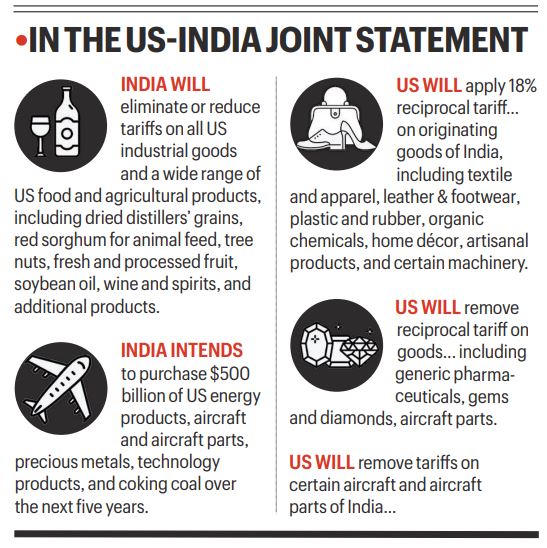
While the US will reduce tariffs on Indian goods to 18 per cent from 50 per cent, India will eliminate or cut down import duties on all US industrial goods and a range of American food and agricultural products. The first phase of the pact is expected to be signed by mid-March.
India has secured concessions on certain aircraft and aircraft parts, tariff rate quota for automotive parts and generic pharmaceuticals and has eliminated duty on bike, automobiles, industrial goods, as well as “wide range” of US food and agricultural products, including soybean oil, tree nuts and fresh and processed fruit among others
Story continues below this ad
The joint statement said: “India will eliminate or reduce tariffs on all US industrial goods and a wide range of US food and agricultural products, including dried distillers’ grains (DDGs), red sorghum for animal feed, tree nuts, fresh and processed fruit, soybean oil, wine and spirits, and additional products. Recognising the importance of working together to resolve long-standing concerns, India also agrees to address long-standing non-tariff barriers to the trade in US food and agricultural products.”
“The United States will also remove tariffs on certain aircraft and aircraft parts of India imposed to eliminate threats to national security… India will receive a preferential tariff rate quota for automotive parts subject to the tariff imposed to eliminate threats to national security found … Contingent on the findings of the US Section 232 investigation of pharmaceuticals and pharmaceutical ingredients, India will receive negotiated outcomes with respect to generic pharmaceuticals and ingredients,” the statement said.
The interests of our farmers remain paramount in all trade negotiations. The Modi Government remains fully committed to protecting our Annadatas and securing rural livelihoods.
No concessions have been extended to sensitive agricultural sector produce in grains, fruits,… pic.twitter.com/6QiohiyKL5
— Piyush Goyal (@PiyushGoyal) February 7, 2026
Commerce Minister Goyal told reporters that Indian products such as tea, coffee, vegetable oil, cashew nut, banana, mango and papaya will enter the US at zero duty. US had in November itself exempted food items from reciprocal tariffs following pushback from American consumers.
He said India has safeguarded sensitive sectors and has not extended any duty concessions on meat, poultry, all dairy products, GM (genetically modified) food products, soy meal, maize, cereals, millets like jowar, bajra, ragi, kodo, amaranth, fruits like banana, strawberries, cherries, and citrus fruits.
Story continues below this ad
Green peas, kabuli chana, moong, oilseeds, certain animal feeds, groundnuts, honey, malt and its extracts, non-alcoholic beverages, flour and meals, starch, essential oils, ethanol for fuel, and tobacco have also been protected, he said.
He clarified that India has not got concessions on Section 232 tariffs on steel, aluminium and copper, saying India will not lose competitiveness on these items as the Section 232 tariffs are the same for all countries.
The joint statement said India “intends” to purchase $500 billion of US energy products, aircraft and aircraft parts, precious metals, technology products, and coking coal over the next five years. “In the event of any changes to the agreed-upon tariffs of either country, the United States and India agree that the other country may modify its commitments,” it stated.
Government officials said India has given market access to American bikes and automobiles, agreeing to zero-duty access to US motorcycle manufacturers for bikes with engine capacities of 800-1,600 cc that would help the entry of Harley-Davidson, addressing one of Trump’s chief concerns in the run-up to the trade deal.
Story continues below this ad
As India announced a tax holiday for data centres, the joint statement said the two countries will “significantly increase trade in technology products”, including Graphics Processing Units (GPUs) and other goods used in data centres, and expand joint technology cooperation.
“The United States and India will address non-tariff barriers that affect bilateral trade. India agrees to address long-standing barriers to the trade in US medical devices; eliminate restrictive import licensing procedures that delay market access for, or impose quantitative restrictions on, US Information and Communication Technology (ICT) goods; and determine, with a view towards a positive outcome, within six months of entry into force of the Agreement whether US-developed or international standards, including testing requirements, are acceptable for the purposes of US exports entering the Indian market in identified sectors,” the statement said.