4 min readNew DelhiFeb 2, 2026 05:55 AM IST
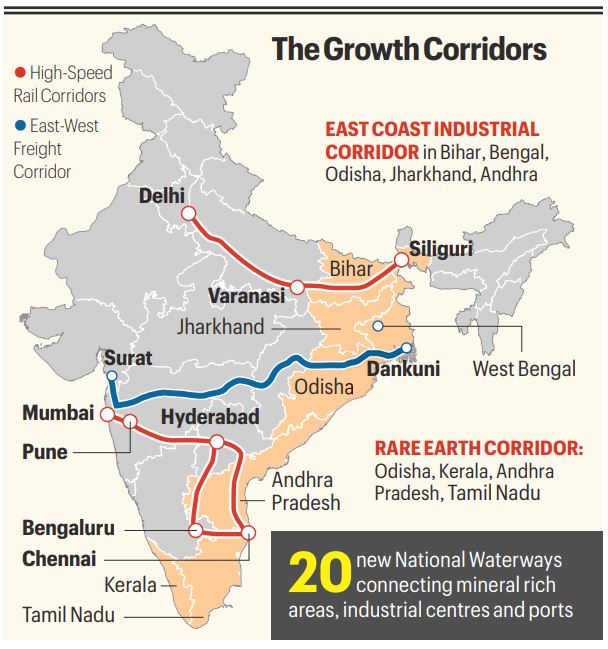
In a major boost for connectivity, Finance Minister Nirmala Sitharaman on Sunday announced seven high-speed rail corridors that will be developed as “growth connectors”. She also announced a new dedicated freight corridor connecting Dankuni in West Bengal to Surat in Gujarat, and “rare earth corridors” in mineral-rich states “to promote mining, processing, research and manufacturing”.
“For an environmentally sustainable system, we will develop seven high-speed rail corridors between cities as growth connectors, namely Mumbai–Pune, Pune-Hyderabad, Hyderabad-Bengaluru, Hyderabad-Chennai, Chennai-Bengaluru, Delhi-Varanasi, and Varanasi-Siliguri,” Sitharaman said in her Budget speech.

India is currently developing its first high-speed rail corridor, the bullet train project, between Mumbai and Ahmedabad. The first stretch, Surat-Billimora, is scheduled to be operational by August 15, 2027; the entire corridor is scheduled to be operational by 2029.
Addressing a press conference later, Railways Minister Ashwini Vaishnaw said these seven new high-speed corridors are estimated to cost about Rs 16 lakh crore and will have significant multiplier effect on the economy, like Japan, South Korea and China, where the high-speed rail network is well-developed.
“These seven new high-speed corridors, which span 4,000 kms, will completely transform India’s transportation sector. Chennai, Bengaluru, Hyderabad will be the South’s high-speed corridor. The travel time between Chennai and Bengaluru will be reduced to just 1.13 hours. Similarly, Bengaluru-Hyderabad will be covered in two hours, and Chennai-Hyderabad in 2.55 hours. The travel time between Mumbai to Pune will be just 48 minutes, and Pune to Hyderabad 1.55 hours. In North India, Delhi-Varanasi distance will be covered in 3.50 hours, and Varanasi to Siliguri via Patna in 2.55 hours,” Vaishnaw said.
He said work on all seven corridors would go on simultaneously, adding that the detailed investment plan would be released later.
Meanwhile, the 2,052-km East-West freight corridor — the third such project — will be linked to the Western Dedicated Freight Corridor, which is nearing completion. This will also enhance port connectivity and cargo evacuation efficiency.
Story continues below this ad
“Operationalise 20 new National Waterways (NW) over next five years, starting with NW-5 in Odisha to connect mineral rich areas of Talcher and Angul and industrial centres like Kalinga Nagar to the ports of Paradeep and Dhamra…Further, a ship repair ecosystem catering to inland waterways will also be set up at Varanasi and Patna,” Sitharaman said in her speech.
The main terminals in NW-5 are Kakudi, Kurunti and Pankapal, and major cargo are coal, coking coal & limestone. The total cost of the project is Rs 13,000 crore.
In her speech, Sitharaman also proposed dedicated “rare earth corridors” in mineral-rich states, and import duty exemption on capital goods needed for processing critical minerals to boost mining and processing activities. This is significant in view of the government’s focus on promoting rare earth or critical minerals to reduce import dependence.
“We now propose to support the mineral-rich States of Odisha, Kerala, Andhra Pradesh and Tamil Nadu to establish dedicated rare earth corridors to promote mining, processing, research and manufacturing,” she said.
Story continues below this ad
Sitharaman also proposed an integrated East Coast Industrial Corridor, with a well-connected node at Durgapur, creation of five tourism destinations in the five Purvodaya States (Bihar, Jharkhand, West Bengal, Odisha and Andhra Pradesh), and the provision of 4,000 e-buses.
The announcement of high-speed rail corridors aligns with the Centre’s push for higher capital expenditure. The government has allocated Rs 2.93 lakh crore as capital outlay for the Railways, and Rs 2.94 lakh crore for Road Transport and Highways. In 2024-25, the total capex for Railways was Rs 2.52 lakh crore, and Rs 2.85 lakh crore for Road Transport and Highways.
The high-speed projects are cost and time intensive. The cost of the first bullet train project has almost doubled to Rs 1.98 lakh crore. The total estimated cost at the beginning of the project was Rs 1.08 lakh crore. The project has been delayed due to various issues including land acquisition and the Covid-19 pandemic.

© The Indian Express Pvt Ltd