4 min readMumbaiUpdated: Feb 3, 2026 09:13 AM IST
Flagging a sharp surge in ‘large-group unconditional cash transfer schemes’ across states, the 16th Finance Commission has warned that a growing reliance on cash handouts could destabilise state finances. It called for a periodic and rigorous review of subsidies, rationalisation of the beneficiary base, and clear sunset or exit clauses.
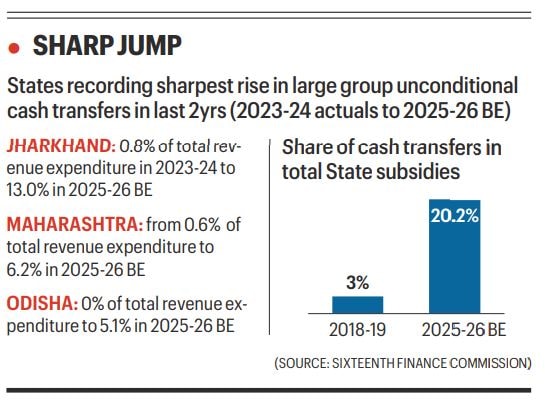
The Commission singled out BJP-ruled Maharashtra and Odisha, and opposition-ruled Jharkhand, as among the states that have seen the steepest rise in such spending over the past two years. In its report for the 2026–31 period, tabled in Parliament on Sunday, the Commission, chaired by economist Arvind Panagariya, said this trend has significantly reshaped how states spend on subsidies. Across 21 states, large cash transfer schemes — which involve direct payments to beneficiaries without performance benchmarks or conditions on how the money is used — now account for more than one-fifth or 20.2% of total subsidy spending in the 2025–26 Budget Estimates, up sharply from just 3% in 2018-19.

ALSO READ | FC bats for discom privatisation, debt clean-up via SPVs
At present, the largest such schemes are Maharashtra’s Majhi Ladki Bahin Yojana (Rs 1,500 a month to eligible women), Karnataka’s Gruha Lakshmi (Rs 2,000 a month for women heads of households), and West Bengal’s Lakshmir Bhandar (Rs 1,200 a month for SC/ST women and Rs 1,000 for women from the general category), the report said.
The review process, the Commission said, must ensure benefits reach the most vulnerable and help reduce, and eventually eliminate, revenue deficits. “There is a need to introduce sunset clauses, especially in schemes that provide subsidies on non-merit private goods and general unconditional transfers,” it said, recommending that governments put in place formal mechanisms to periodically review such subsidies. It also pointed to a shift within the universe of unconditional cash transfers. While social security for pensioners and farmers accounted for the bulk (or 84%) of such spending in 2018–19, large cash transfer schemes such as the three above now make up nearly half (or 47.4%) of all unconditional transfers, overtaking both categories by 2025–26.
The Commission attributed this shift in part to improvements in delivery systems, noting that while the Jan Dhan–Aadhaar–Mobile (or JAM) trinity has reduced leakages and improved efficiency, it has also made cash payments to broad population groups a preferred welfare instrument for states.
Such transfers recorded a trend growth of 53.6% between 2018-19 and 2025-26, with total outlay projected to reach Rs 1.96 lakh crore in 2025-26. However, the Commission notes that a large part of the expansion has occurred after 2023–24, indicating a recent acceleration rather than a gradual build-up.
Story continues below this ad
For instance, Maharashtra’s spending on large group cash transfers jumped from 0.6% of total revenue expenditure in 2023-24 to 6.2% in 2025-26 (Budget Estimates). In Jharkhand such spending rose from 0.8% to 13% over the same period and Odisha also recorded a sharp rise, from nil to 5.1% over the same period.
ALSO READ | Finance Commission strikes a balance – addresses southern states’ concerns, and equity
“If major States continue to allocate rising proportions of revenue expenditures to large-group unconditional cash transfers, they will not only impose a significant burden on the States’ budgets but also destabilise their finances in the long run,” the report states immediately after referring to the jump in cash transfer spending of Maharashtra and Odisha in the last two years. In Maharashtra, the Maha Yuti government led by BJP, Eknath Shinde led Sena and Ajit Pawar led NCP had introduced the Majhi Ladki Bahin Yojana in July 2024. As part of the scheme, a monthly instalment of Rs 1,500 is given to the eligible women. Till January, there were 2.3 crore beneficiaries of the scheme.
The scheme was introduced after MahaYuti met with a drubbing in 2024 Lok Sabha polls. Leaders in BJP and its allies attribute the victory in the Assembly elections later in the year to the scheme. The Commission has warned that many subsidy schemes, particularly large, unconditional cash transfers, have expanded into “large and untargeted beneficiary bases”, making them inefficient and fiscally costly. Such schemes, it said, “not only impose a large fiscal burden” but also “crowd out capital expenditure and other critical expenditures related to the provision of basic services, such as education and health”.
Story continues below this ad
It cautioned that financing these schemes through off-budget borrowings, guarantees or revenue assignments is “fiscally imprudent”, as it creates opacity in public accounts, and said such practices should be discontinued and actively discouraged.

© The Indian Express Pvt Ltd