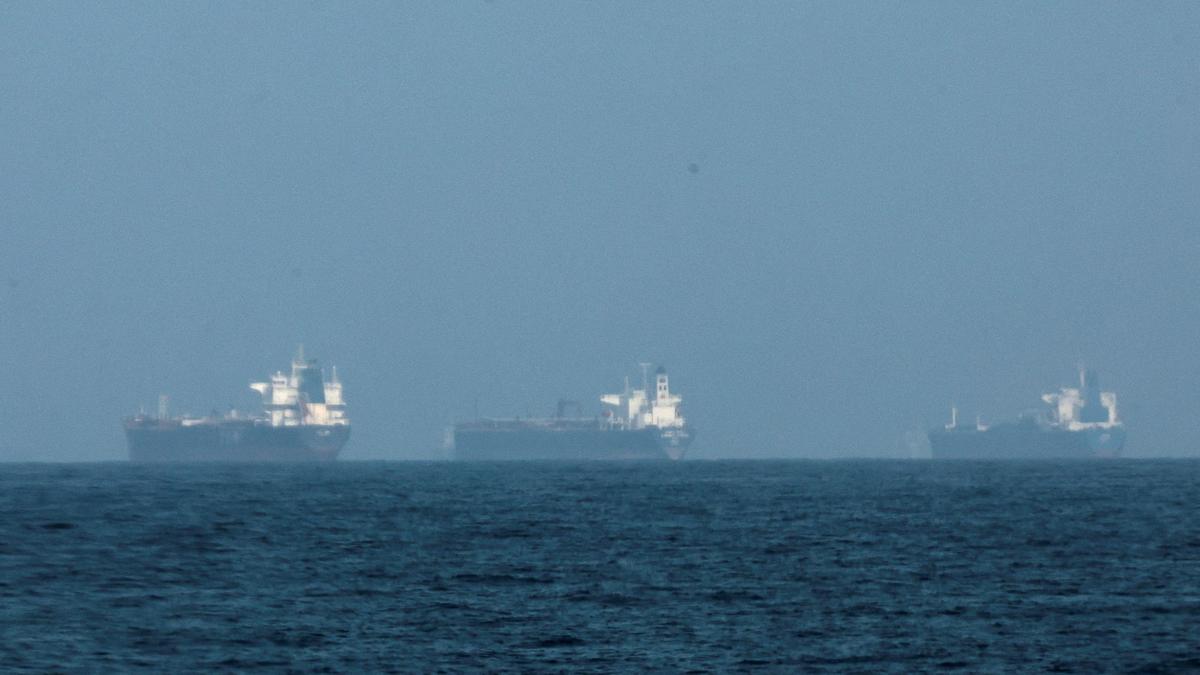
Tankers are seen off the coast of the Fujairah, as Iran vows to close the Strait of Hormuz, amid the U.S.-Israel conflict with Iran, in Fujairah, United Arab Emirates.
| Photo Credit: Amr Alfiky
The escalating war in West Asia is putting India’s oil and gas imports under stress with tankers and gas carriers bound for India stranded in the Persian Gulf and Qatar shutting down its Liquified Natural Gas (LNG) production facility.
Some 200 internationally-trading crude oil and product tankers are stranded in the Persian Gulf following a total stoppage of ship movement across the Strait of Hormuz, as per Lloyds List Intelligence. Their data shows that while China’s Sinokor has the most ships stranded among all owners, Indian government-owned Shipping Corporation of India (SCI) too is a leading owner whose assets are stranded. SCI ships with cargo carrying capacity of almost 8 lakh tonne are stranded. Sanmar Shipping, part of the Chennai-based Sanmar Group, has ships with 3 lakh tonne of cargo capacity there.
At least 22 Indian flagged oil tankers and gas carriers with nearly 400 Indian seafarers onboard are stranded in Persian Gulf, reports Anil Devli, CEO of Indian National Shipowners’ Association. More than 35 Indian flagged ships are in the region, he says.
Most of the stranded ships are at anchor while owners and charterers await clarity on transiting the chokepoint of Strait of Hormuz.
All of India’s Liquified Petroleum Gas (LPG) needs are imported from Qatar and Saudi Arabia and they have been stressed too.
The Indian government has said that India is in a “reasonably comfortable position” with 25 days of crude oil in reserves not including the emergency-earmarked Special Petroleum Reserves and two to three weeks of LNG reserves. The government has assured that it had already been looking at diversifying LPG supplies.
Overall, the Indian flag has some 140 oil tankers and gas carriers. Many unloaded Indian oil tankers and gas carriers are awaiting orders from oil companies to proceed to other ports for alternative sources, said Mr. Devli. Saudi Arabia is seeking to pipe fuel supplies to its ports on the Red Sea such as Yanbu as alternative export points, says Mr. Devli, adding that ships calling on those ports, however, run the risk of being targeted by Houthis.
Qatar has halted LNG production after its facilities came under attack amid the ongoing West Asia conflict, disrupting supplies to India and squeezing feedstock availability for key domestic sectors.
India, which depends on long-term LNG contracts with Qatar for 40% of its annual natural gas needs, has seen a temporary suspension of cargoes.
While some industrial users can switch to alternative – though costlier – fuels, the CNG-retailing city gas sector has warned of severe stress. City Gas Distribution operators said replacing contracted Qatari volumes with spot LNG priced at more than double the contracted rate could erode CNG’s price advantage and result in a permanent shift of customers to electric vehicles.
In a stock exchange filing, Petronet said it has sent force majeure notice to Qatari supplier, QatarEnergy for inability to send ships.
QatarEnergy too has served a force majeure notice for inability to serve its buyer – Petronet LNG – due to hostilities in the region.
Petronet has a long-term contract to buy 8.5 million tons per annum of LNG from Qatar. Additionally, it buys Qatari LNG from the spot market as well. Besides Petronet, companies such as IOC have LNG import contracts with the UAE.
Petronet LNG has three dedicated LNG carriers with 25-year contracts for Qatari LNG from Ras Laffan to Dahej. The three ships, Disha, Raahi, and Aseem are operated and managed by the SCI. (With PTI inputs)
Published – March 04, 2026 09:34 pm IST