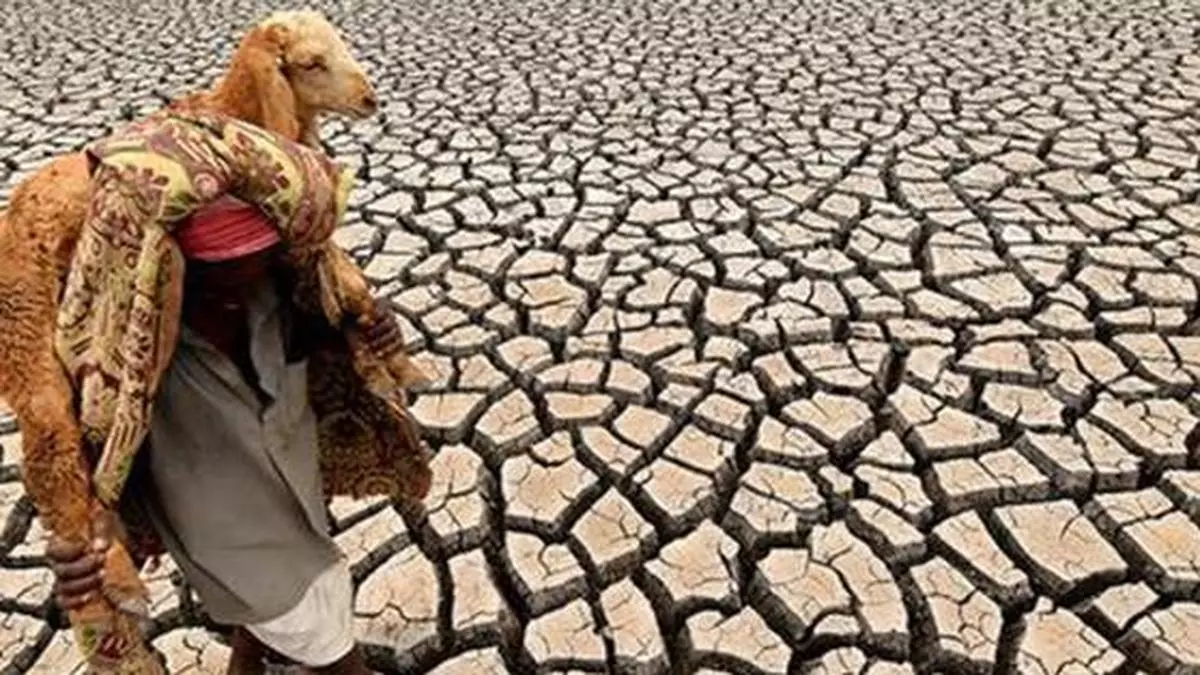
An El Nino weakens India’s south-west monsoon, often leading to drought conditions
| Photo Credit:
Nagara Gopal
Chances of an El Niño event emerging later this year are increasing, even as the current La Niña episode is weakening, according to the World Meteorological Organization (WMO). ENSO-neutral conditions are likely to continue through mid-2026, with the chances of warming increasing further by May–July, before an El Niño sets in.
Forecasts are uncertain, largely due to the boreal spring predictability barrier, but the possible shift could significantly reshape global rainfall patterns, temperatures and climate-sensitive sectors, said the global weather body.
El Niño is the large-scale warming of ocean surface temperatures in the central and eastern equatorial Pacific Ocean, along with associated shifts in tropical atmospheric circulation, including changes in wind patterns, air pressure and rainfall distribution.
An El Niño weakens India’s south-west monsoon, often leading to drought conditions. In 2023, the event set in during June and lasted for 11 months. It impacted food grain output, particularly paddy and pulses, resulting in lower production levels. The fallout also drove up food inflation.
Two Japanese scientists have predicted a strong probability of a Super El Niño developing, along with the Indian Ocean Dipole emerging during the period.
Rising odds
Forecasts from the WMO’s Global Producing Centres indicate a 60 per cent probability of ENSO (El Niño–Southern Oscillation) neutral conditions — meaning neither El Niño nor La Niña — during March–May 2026, rising to 70 per cent in April–June.
During May–July, the probability of neutral conditions stands at 60 per cent, while the likelihood of an El Niño is up at around 40 per cent.
Forecast limits
However, forecast uncertainty increases at longer lead times because of the boreal spring predictability barrier, a limitation that reduces the skill of ENSO outlooks.
The boreal spring predictability barrier refers to the drop in ENSO forecast accuracy during the Northern Hemisphere spring. Weaker ocean–atmosphere coupling and seasonal transition dynamics make climate models highly sensitive to background noise, limiting the reliability of long-range forecasts for El Niño and La Niña events until summer.
Global Signals
The latest WMO Update says that for March–May 2026, there is a clear global signal pointing to above-average land surface temperatures. Rainfall forecasts in the equatorial Pacific indicate a lingering La Niña–like pattern, while signals elsewhere remain mixed and less consistent.
Published on March 3, 2026