5 min readNew DelhiUpdated: Feb 4, 2026 10:30 PM IST
Antitrust watchdog Competition Commission of India (CCI) has ordered a detailed investigation into whether IndiGo’s conduct in early December, when it faced an operational meltdown that involved large-scale flight cancellations and a surge in ticket prices across airlines, amounted to an abuse of its dominant position as India’s largest carrier. With scores of IndiGo flights cancelled on a daily basis in the first week of December, India’s aviation system was brought to its knees given that IndiGo commanded a domestic market share of 65%.
The disruption led thousands of passengers stranded at airports across the country. There were demands from some quarters for a CCI inquiry to determine whether IndiGo indulged in anti-competitive practices or abuse of dominant position. On the worst day of the disruption—December 5—over 1,600 of the airline’s 2,300-plus daily flights were cancelled. The disruption’s peak—December 3-5—saw 2,507 IndiGo flights cancelled and another 1,852 delayed.

The crisis led to a surge in airfares of other airlines as well, due to a last-minute scramble for tickets, and the government had to intervene by imposing distance-based airfare caps. On December 18, the CCI announced that it had taken cognizance of information filed by a complainant against IndiGo. The airline has already faced action from aviation regulator Directorate General of Civil Aviation (DGCA), which imposed penalties totalling Rs 22.20 crore on the airline for the disruption, and warned its top management personnel.
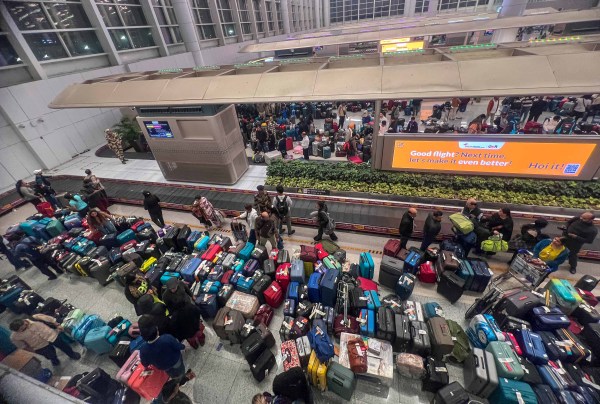 Passengers of cancelled flights searching for their baggages at terminal 1 of IGI airport followed by the indigo flight disruptions on Thursday night. (Express photo by Arul Horizon)
In its 16-page order issued on Wednesday, the competition watchdog observed that by cancelling thousands of flights—constituting a significant portion of its scheduled flight capacity—the airline may have created an “artificial scarcity,” thereby limiting consumer access to air travel during peak travel season. It said that such conduct by a dominant enterprise may be viewed as restricting the provision of services under Section 4(2)(b)(i) of the Competition Act.
“It is observed that passengers who had booked tickets were left with no real choice but to accept last-minute cancellations. Further, passengers were left to seek alternatives, on their own, at significantly higher prices. Given IndiGo’s dominant position, consumers were effectively locked in and lacked viable alternatives which appears to be in violation of the provisions of Section 4(2)(a)(i) of the (Competition) Act,” the CCI said, while ordering the investigation that is to be completed in 90 days.
Section 4 of the Competition Act deals with issues about abuse of dominant position. The Commission also observed that the disruptions were not limited to a few routes but occurred simultaneously across a wide network. The investigation is expected to examine how this conduct constrained consumers’ access to domestic flights, creating a “system-wide capacity shock”.
In its submission to the CCI, IndiGo argued that the Commission did not have the jurisdiction to hear the case, saying that the matter should be handled exclusively by the DGCA. The competition regulator rejected IndiGo’s argument, and said that while the DGCA handles operational supervision, only the CCI is empowered to deal with anti-competitive acts through the lens of the Competition Act.
Story continues below this ad
IndiGo’s under-preparedness for the second phase of the new rest and duty norms for pilots was the key reason for the crisis. The situation stabilised after the DGCA allowed IndiGo a temporary exemption till February 10 from a few night duty-related changes in the new Flight Duty Time Limitation (FDTL) rules for pilots. IndiGo’s operations have been stable since, with the airline now operating over 2,200 daily flights. As per the DGCA, IndiGo admitted that it was short on pilots vis-à-vis the requirement under the new FDTL norms and that the disruptions arose “primarily from misjudgement and planning gaps in implementing” the rules’ second phase that took effect on November 1.
According to experts, a company’s dominance by itself is not considered anticompetitive, but abuse of dominant position is. Abuse occurs when one or more companies use their dominant market position in an exclusionary or an exploitative manner—like opportunistic pricing and denial of market access—that negatively impacts competition. Among other actions, the CCI can impose hefty financial penalties—up to 10 per cent of the average turnover of the company for the past three years—if its probe reveals abuse of dominant position.
In all, Indian airlines fly around 1,200 domestic routes, of which IndiGo has over 950 routes in operation. Notably though, over 600 of these are monopoly routes, and about 200 (21 per cent) are duopoly routes where IndiGo has just one competitor. But experts point out that IndiGo’s monopoly on a significant number of routes and the duopoly in India’s airline sector is not really by design, and much of it can be attributed to the failure of other domestic airlines to compete effectively, and even survive. Many have gone under over the past couple of decades—Go First and Jet Airways being the biggest examples over the past few years.
“The domestic passenger aviation market exhibits very high and increasing concentration, exhibiting that leading firms possess the ability to operate independently of competitive forces, as the presence of effective rivals is materially constrained,” the CCI said in its order.


© The Indian Express Pvt Ltd