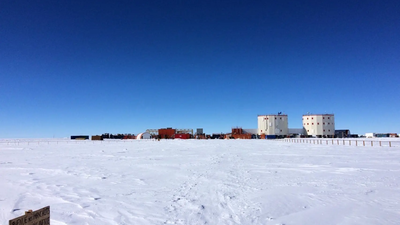
Scientists in Antarctica have inaugurated the world’s first global repository of mountain ice cores, aiming to preserve vital records of Earth’s atmospheric history as glaciers rapidly melt due to global warming.The frozen sanctuary was opened on Wednesday at the Concordia research station on the Antarctic Plateau by the Ice Memory Foundation, a consortium of European research institutes. The foundation livestreamed the ceremony, which included the opening of a cave carved deep into compacted snow where the ice cores will be stored for future generations, news agency AP reported.Ice cores act as atmospheric time capsules, preserving traces of past climate conditions, including gases, aerosols, pollutants and dust trapped in layers of ice over centuries. With glaciers disappearing at an unprecedented rate, scientists are racing to extract and conserve these samples before they are lost forever.“These ice cores are not relics, they are reference points,” the Associated Press quoted Celeste Saulo, secretary-general of the UN World Meteorological Organization as saying. “They allow scientists now and in the future to understand what changed, how fast and why.”.The first ice cores stored in the vault were drilled from Mont Blanc in France and the Grand Combin massif in Switzerland. They reached Concordia station after a 50-day journey by refrigerated icebreaker and aircraft from Trieste, Italy.During the inauguration, foundation members carried box after box of ice cores into the cave, which is burrowed into a five-metre-high compacted snow drift and maintained at a constant temperature of around minus 52 degrees Celsius.“By safeguarding physical samples of atmospheric gases, aerosols, pollutants and dust trapped in ice layers, the Ice Memory Foundation ensures that future generations of researchers will be able to study past climate conditions using technologies that may not yet exist,” said Carlo Barbante, vice-chair of the foundation and a professor at Ca’ Foscari University in Venice.The Ice Memory project was launched in 2015 by research institutions from France, Italy and Switzerland, including France’s CNRS and IRD, Italy’s National Research Council and Ca’ Foscari University, and Switzerland’s Paul Scherrer Institute.Scientists have already identified and drilled ice cores from 10 glacier sites worldwide and plan to transport them to the Antarctic sanctuary in the coming years. Over the next decade, the project aims to establish an international convention to preserve and safeguard the samples for future study.According to the foundation, glaciers have lost between 2% and 39% of their ice regionally since 2000, with a global average loss of about 5%, leading to the disappearance of critical atmospheric records.